
Published 20/07/2026

Published 20/07/2026
Decarbonising industrial heat is one of the most complex challenges facing the construction supply chain today.
For manufacturers, where high-temperature processes are essential, reducing emissions while maintaining performance, quality and cost requires careful balance.
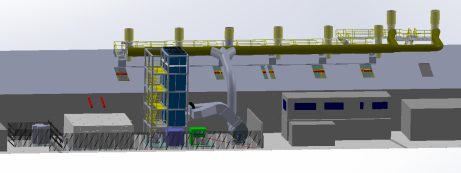
At wienerberger, we are addressing this challenge in practical, measurable ways. At our Warnham brickworks, a heat recovery and heat pump system is already showing how energy-intensive processes can be reimagined, delivering measurable emissions reductions while maintaining consistent production.
Brick production relies on large-scale drying processes, where heated air removes moisture from clay products.
At Warnham, this process generated substantial volumes of warm, moisture-laden exhaust air, much of which was previously vented to atmosphere.
Capturing and reusing this low-grade heat presented a clear opportunity, but also a complex technical and operational challenge, particularly within a site running continuous production.
As Greg Crownshaw, Thermal Process Engineer, explains:
“We could see there was energy leaving the process that we weren’t making full use of. The challenge was finding a way to recover it without disrupting how the factory runs day to day.”
At Warnham, that opportunity has now been realised.
The £4.5 million project, supported by the Industrial Energy Transformation Fund (IETF), combines heat recovery with industrial-scale heat pump technology to transform how energy is managed within the production process.
Construction began in early 2024, with the system introduced in phases and fully installed by late 2025. This phased approach allowed the technology to be tested, refined and integrated while the factory remained fully operational.
Delivered in partnership, the project brought together:
The system:
In parallel, recovered water is filtered and reused—improving overall resource efficiency.


Following installation and commissioning in late 2025, the impact is already clear, with measurable improvements across carbon, energy and resource use.
As Greg Crownshaw adds:
“What’s important is that this isn’t just about reducing emissions. It’s about improving how the process performs overall — making it more efficient, more consistent and more future-ready.”
As the industry works to reduce embodied carbon and demonstrate real progress, attention is increasingly turning to how materials are produced, not just how they perform.
Projects like Warnham’s heat pump show that meaningful change is possible within existing manufacturing processes. By recovering and reusing energy that would otherwise be lost, it is possible to reduce reliance on fossil fuels, improve resource efficiency and maintain consistent output.
Crucially, this approach shows that decarbonisation does not have to come at the expense of reliability or scalability. Instead, it can strengthen resilience across the supply chain, helping the industry move forward with greater confidence.
The Warnham project is not just about what has been achieved, but what it makes possible next.
It shows how:
As Greg Crownshaw explains:
“This gives us something we can build on. We’ve been able to develop, test and refine the approach here, and that creates a strong foundation for applying it more widely.”
This moves industrial decarbonisation from concept to delivery, providing a practical model for wider adoption.
This project reflects how wienerberger is building for what’s next, applying innovation in ways that deliver measurable outcomes and support lower-carbon manufacturing.
Work at Warnham continues, with further optimisation already underway. As these insights are applied more widely, the site is becoming a proven reference point, helping to accelerate the transition to more sustainable manufacturing across the business.
Crucially, the project contributes directly to wienerberger’s wider decarbonisation ambitions. By reducing emissions from one of the most energy-intensive stages of production, it supports the company’s target to achieve a 42% reduction in Scope 1 and 2 emissions by 2030 (from a 2020 baseline), while progressing towards long-term net-zero goals. This demonstrates how targeted innovation at site level can scale to deliver meaningful impact across the wider business and the construction supply chain.


