
Published 27/07/26

Published 27/07/26
As solar PV becomes a standard feature of residential construction, one of the most debated questions in roofing specification remains unresolved. In this article, Jacob Hill, Head of Category – Roofing & Renewables at wienerberger UK & Ireland, explores how integrated solar is changing moisture behaviour in pitched roofs, why membrane specification is becoming more complex, and how real-world research is helping to build the evidence base needed for more confident decision-making.
As solar PV becomes standard in residential construction, it is beginning to challenge one of the most fundamental assumptions in pitched roof design: that moisture behaviour is predictable.
For specifiers and designers, this shift is significant. Decisions around membrane specification, ventilation and detailing must now respond to changing roof conditions, where energy generation, airflow and moisture management are increasingly interconnected. With greater pressure to demonstrate compliance, manage risk and ensure long-term solar roof performance, reliance on assumed behaviour is no longer enough.
The rapid growth of rooftop solar means questions around roof design can no longer be treated as theoretical. Government initiatives such as the Future Homes Standard and Warm Homes Plan are expected to accelerate adoption of solar PV across both new-build and retrofit housing, increasing the number of roofs required to balance energy generation, durability and moisture management within a single building system.
As solar adoption grows, specifiers are increasingly examining how integrated solar interacts with the wider roof construction and whether established approaches to membrane selection remain appropriate.
For decades, pitched roofs have been designed around a simple principle: moisture must move safely through the structure. Ventilation strategies, material selection and detailing work together to ensure that moisture dissipates in a controlled and predictable way.
However, solar PV roofing design is altering that dynamic.
Integrated solar systems can create areas that behave more like impermeable surfaces, limiting airflow and changing the way moisture is distributed within the roof build-up. When this condition extends across large areas, it begins to affect the assumptions that underpin traditional ventilation strategies.
This introduces new uncertainty into how moisture behaves in pitched roofs, particularly beneath solar arrays.
Roofing membranes have long been a familiar and well-understood element of pitched roof construction. In conventional systems, membrane specification has typically been guided by established standards, proven performance and a shared understanding of how different materials behave.
The presence of solar PV changes that context. Membrane performance is now influenced by its interaction with ventilation strategy and solar installation. What was once a relatively straightforward decision becomes part of a wider system consideration.
For specifiers, this represents a subtle but important shift. Membrane selection is no longer just about choosing a suitable product, it becomes a decision that impacts overall roof performance, durability and compliance outcomes.
In the absence of consistent, solar-specific guidance, three broad approaches to membrane specification have emerged.
This approach prevents moisture transfer from the loft space into the batten cavity, eliminating the risk of moisture accumulating within that part of the roof construction. However, it places greater reliance on effective low- and high-level ventilation to remove moisture from the roof space itself, making good detailing and airflow management critical to long-term performance.
These remain the most widely specified underlays in pitched roofing. They allow water vapour to pass through the membrane while maintaining weather resistance. The challenge beneath solar PV is understanding whether moisture that enters the batten cavity can continue to dissipate effectively when a substantial area above is covered by an impermeable solar array.
Air permeable membranes allow both air and moisture vapour to move through the roof construction and can reduce the reliance on supplementary ventilation measures. However, they raise similar questions regarding moisture behaviour beneath solar modules and are often used in roof designs with fewer additional ventilation provisions.
Each approach is supported by sound technical reasoning and may be appropriate under certain conditions. However, they all rely, to some extent, on assumptions about how moisture behaves beneath integrated solar systems. The key question remains unresolved: how does moisture actually behave beneath a solar PV installation over time?
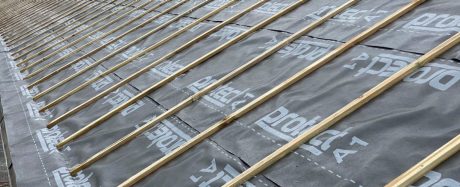
While guidance continues to evolve, there is currently no dedicated British Standard test methodology or universally accepted industry approach specifically assessing membrane performance beneath integrated solar systems. While NHBC Standards classify roofs containing integrated in-roof solar PV as impermeable roof coverings, questions around condensation risk, moisture movement and long-term roof performance remain the subject of ongoing debate.
As a result, much of today's understanding is based on modelling, simulation and the application of established roofing principles to new conditions. While valuable, these approaches predict performance rather than demonstrating how roofing systems behave in practice over time.
At the same time, expectations placed on specifiers continue to rise. Decisions must increasingly be justified against long-term performance, regulatory requirements and risk management considerations. Without a stronger evidence base, assessing solar roof performance and selecting the most appropriate membrane strategy becomes more difficult.
Addressing this uncertainty requires a shift in approach, from modelling to monitoring.
Real buildings are dynamic environments. Factors such as occupancy, heating patterns, humidity and weather conditions all influence how moisture behaves within a roof structure. Understanding moisture in pitched roofs with solar PV therefore requires observation under real operating conditions.
Across the industry, this is driving increased focus on real-world testing and monitoring, helping specifiers make more informed, defensible decisions based on measured performance rather than assumption.
Recognising the need for more robust evidence, manufacturers and researchers are increasingly turning to full-scale monitoring programmes that assess performance under realistic operating conditions rather than relying solely on laboratory modelling.
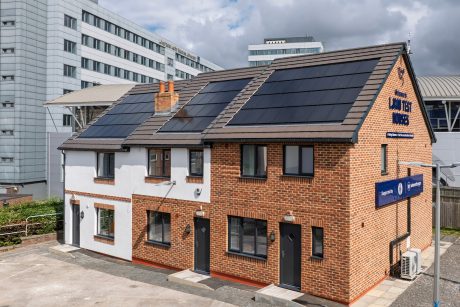
One such initiative is a collaborative research project between wienerberger and Liverpool John Moores University (LJMU), which is investigating how different membrane types perform beneath integrated solar installations. The project uses three full-scale roof constructions designed to replicate real residential conditions.
A network of sensors continuously monitors temperature, humidity, moisture content, dew point and heat index within both the loft space and batten cavity. By observing roof behaviour over an extended period, researchers are building a more detailed understanding of how different membrane approaches perform in real-world conditions.
While detailed analysis continues, monitoring has already begun to reveal important insights.
One finding is that batten cavities beneath integrated solar systems operate at higher temperatures than equivalent areas beneath traditional tiled roof coverings. For the first time, the industry has access to measured operational data that helps quantify these conditions under real service environments.
This has implications beyond the immediate membrane debate. Industry stakeholders have previously questioned whether elevated temperatures could influence the long-term durability of products located within the batten cavity. Measured data creates a more credible basis for future performance testing and accelerated ageing assessments, allowing products and systems to be evaluated against conditions that more accurately reflect how integrated solar roofs perform in practice.
As solar PV becomes embedded in mainstream residential construction, roofing design is entering a period of transition. Membrane specification can no longer be viewed as an isolated product choice. Instead, it must be considered as part of a wider roofing system shaped by energy generation, airflow, moisture management and long-term durability.
The industry's challenge is no longer identifying potential risks, but generating the evidence needed to understand them with confidence. Whether future research confirms existing approaches or highlights the need for different specification strategies, robust real-world data will help create clearer guidance, reduce design uncertainty and support more consistent decision-making across the sector.
As the evidence base develops, specifiers will be better equipped to deliver durable, compliant solar-integrated roofing systems. The direction of travel is clear: from assumption towards evidence-led specification.

