
Published 28/04/26


Published 28/04/26
Across the UK, residential architecture is undergoing a profound transformation. Housing providers are demanding buildings that perform better, last longer, and feel more deeply connected to their surroundings. At the same time, construction professionals are pushing creativity and sustainability into new territory - and clay is playing a central role in that evolution.
From carbon-neutral suburban homes to sculptural rural retreats, the following five case studies use wienerberger products to demonstrate how clay is helping to redefine what the modern British home can be.


Product used: Forum Smoked Branco bricks
Didsbury Park is a pair of detached, carbon-neutral homes that show how clay materials can support high-performance, low-energy suburban housing. The project uses clay walling and roofing systems to deliver airtightness, thermal mass, and long-term durability - all without compromising architectural clarity.
The project demonstrates clay's inherent thermal stability and longevity, making it a natural fit for homes designed to meet ambitious carbon targets while still feeling warm, familiar and rooted in place.


Product used: Keymer Goxhill Tiles
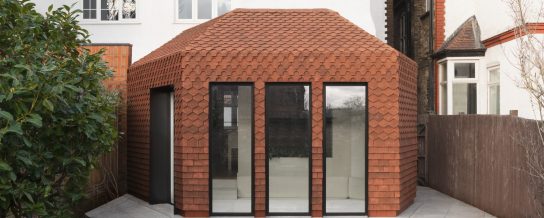
Clay House is a masterclass in material-led design. Clad entirely in Keymer handmade Goxhill Tiles, the home uses clay in a way that feels both heritage and strikingly contemporary. The facade's subtle irregularities, a hallmark of handmade tiles, create a rich, tactile surface that shifts with the light and the seasons.
For anyone exploring alternatives to conventional cladding, Clay House demonstrates how traditional craft materials can be used on modern-day projects. The result is a home that feels deeply personal, expressive, and connected to regional heritage.


Product used: Cassius Antique Slate Tiles
Set within a historic Cheltenham neighbourhood, Copperleaf uses clay roof tiles to create a roofscape that feels both familiar and refreshingly modern. The project balances crisp contemporary detailing with a sensitivity to the surrounding Victorian context - a challenge many architects and designers face when designing in established residential areas.
Clay's natural tonal variation and long-life performance make it an ideal material for projects that must negotiate between heritage and innovation. Copperleaf shows how a carefully considered roof can become the defining architectural gesture of a home.


Product used: Keymer County Peg Antique Tiles
A multi RIBA award-winning country home, its dramatic, sculptural roofscape inspired by traditonal Kent oast houses is clad in Keymer clay tiles, creating a series of interlocking forms that anchor the building in its rural setting.
The project demonstrates how clay can support ambitious architectural expression while maintaining a strong connection to the local area. Caring Wood is a powerful example of how material choice can unify complex massing strategies and elevate multi-generational living into something both functional and poetic.


Product used: Porotherm
Carrowbreck Meadow is one of the UK's first PassivHaus-certified residential developments, and clay sits at the heart of its performance strategy. The project uses our Porotherm clay block system to achieve exceptional airtightness, reduced thermal bridging, and rapid construction times.
For designers and construction professionals working on sustainable housing, Carrowbreck Meadow offers a compelling blueprint. It shows how clay block systems can deliver the rigour of PassivHaus performance while achieving an aesthetic inspired by local barn forms.
A New Chapter for British Housing
Taken together, these five projects reveal a clear shift in the way architects are approaching residential design in the UK. Clay — one of the oldest building materials, is being rediscovered as a tool for innovation, sustainability, and expressive architecture.
Whether used structurally, as cladding, or as a defining roofscape, clay offers a rare combination of performance, longevity, and aesthetic richness. As the demands on housing continue to evolve, these case studies show that the future of British residential architecture may well be rooted in one of its most timeless materials.
Discover more housing case studies below to inspire you for your next big project.
.jpg)


